Showing posts with label Steve McQueen (Director). Show all posts

Wednesday, November 21, 2018

Widows (2018)

Film: Widows (2018)
Stars: Viola Davis, Michelle Rodriguez, Elizabeth Debicki, Cynthia Erivo, Colin Farrell, Brian Tyree Henry, Daniel Kaluuya, Jacki Weaver, Carrie Coon, Robert Duvall, Liam Neeson
Director: Steve McQueen
Oscar History: No nominations
Snap Judgment Ranking: 3/5 stars

Oh man did I get behind on my reviews.  Theoretically I will be going to the movies in a few hours, but it could well just be one flick as I am so behind on my film reviews, particularly for 2018 pictures, that I could easily spend the next day just writing up here and still not get caught up (I am a Thanksgiving orphan today, but am thankful for all of those near and far that I love, particularly this year).  We're going to start out by reviewing the most recent movie I saw and see how far I can get while working my way backwards, with Widows being a picture that I caught on Tuesday night.  Steve McQueen's latest has had a lot of press in the past few days for a poor marketing campaign that resulted in a disappointing box office performance even though the reviews have been kind, with many wondering whether or not it will miss major Oscar nominations like McQueen's last film (Best Picture victor 12 Years a Slave) as a result.  While I can't get to the Oscar question quite yet, I can definitely add in my two cents on the film, and its misleading advertising campaign.

(Spoilers Ahead) The film focuses on the lives of three widows whose husbands, members of Harry Rawlings's (Neeson) mob, recently died.  Harry's widow, Veronica (Davis), is a stoic woman who used to represent the teacher's union, and seems intent to know as little about her husband's dealings as possible, though you get the sense that she knew roughly what was happening and just didn't care.  The two have a seemingly strong marriage, but as the movie progresses, in flashbacks we understand that it was more complicated than that, with their son dying at the hands of a white police officer, and them being increasingly isolated from each other in the years since.  Harry's death resulted in roughly 3 million dollars being burned up, and the two men he stole it from Jamal Manning (Kaluuya), a candidate for alderman, and his sadistic brother Jatemme (Kaluuya), threaten to kill her if they don't get the money.  She recruits two other widows whose husbands died in the same sting that killed Harry named Linda (Rodriguez) and Alice (Debicki), and they plan on finishing Harry's next heist, robbing from the home of Jamal Manning's opponent Jack Mulligan (Farrell), who is looking to succeed his father Tom (Duvall) as City Alderman, with his eyes on one day becoming the Mayor of Chicago.

That's quite the thick plot, and the film, clocking in at 129 minutes, might get its best compliment from me in that it makes total sense and doesn't meander too much as we get to the eventual showdown.  There's little excess here, and McQueen has assembled the sort of ensemble you can only get if your last film won Best Picture.  Seriously-these are some of the best actors working (I haven't even mentioned Carrie Coon, Cynthia Erivo, & Jacki Weaver, all of whom are also on the call sheet), and you don't pull together thespians like this without some terrific work being had.  Debicki has gotten the lion's share of the kudos, and it's partially because this might be her most mainstream effort yet, going toe-to-toe with someone like Viola Davis, but it's probably just because she's sensational.  There's this great scene where she has to play opposite Weaver as her mother, trying to hold back an array of emotions, while the wrong ones keep sputtering out, and I loved the way she seems to be both a vulnerable person and someone who could take on the likes of Davis's Veronica.  Kaluuya gets the showiest part in the cast as Jatemme, a monstrous close-to-cameo role where his huge eyes and deliberate line readings result in genuine fear whenever he's on screen, but Debicki probably is the one who will get the most offers out of this film, and considering I've been cheering her on for years now, that's reason enough to see Widows.

The problem for McQueen's film is that it is marketed as an art house film, but it's frequently too conventional for such things.  That seems to be a problem for box office in recent years (look at something like mother! for another example), but he'd have been better off selling this as a smart action movie, which is what it is.  The further he delves into the marriage of Harry (who, spoiler alert again, is in fact not dead but shacking up with Carrie Coon and their infant son) and Veronica, the less we know about our leading lady.  Davis is a great orator and speech-giver as Veronica, but I'll admit that this felt more like her just showing off than finding a depth in her character.  I had a similar problem with parts of her performance in Fences, with her feeling too theatrical in her delivery, but chalked that up to her having played the part in the Cort Theater and it just came naturally after inhabiting the role for so long.  Widows doesn't have that excuse.  Davis can be mesmerizing, but I left knowing nothing about Veronica, to the point where the ending makes little sense (she sees Alice and smiles...but did she even like Alice?  And why-they hated each other right up until the end of the movie?).  There's stuff on the page that Davis could have taken advantage of, but her marriage feels paint-by-numbers, with her grief only informing certain checks on the film (I loved the way she brought her dog with her everywhere after Jatemme threatened him, not wanting to lose another loved one), but it feels like something was cut or missing on the editing room floor.  Like I said, these actors are too good to be left with a bad movie, which this certainly isn't, but it's also hard not to feel disappointed that considering the talent on-display here (Gillian Flynn wrote it!) that we didn't end up with an indisputable classic.

Friday, January 02, 2015

OVP: Picture (2013)

OVP: Best Picture (2013)

The Nominees Were...


Brad Pitt, Dede Gardner, Jeremy Kleiner, Steve McQueen, and Anthony Katagas, 12 Years a Slave
Charles Roven, Richard Suckle, Megan Ellison, and Jonathan Gordon, American Hustle
Scott Rudin, Dana Brunetti, and Michael de Luca, Captain Phillips
Robbie Brenner and Rachel Winter, Dallas Buyers Club
Alfonso Cuaron and David Heyman, Gravity
Megan Ellison, Spike Jonze, and Vincent Landay, Her
Albert Berger and Ron Yerxa, Nebraska
Gabrielle Tana, Steve Coogan, and Tracey Seaward, Philomena
Martin Scorsese, Leonardo DiCaprio, Joey McFarland, and Emma Tillinger Koskoff, The Wolf of Wall Street

My Thoughts: I honestly don't know why I seem to have to drag these write-ups on-and-on-and-on (I now have a bit of sympathy for those people who keep showing up at these awards shows and losing), but here we are, finishing off our fifth OVP awards, with what will likely be the beginning of the sixth OVP near the beginning of February.  We've been through almost every aspect of all of these films (see the links below for the curious), but we will now go into a cohesive look at all of the pictures, starting with, for no reason in particular, Captain Phillips.

As I stated above, we've dissected most of these films to death, but when it comes to the overall picture, I cannot help but wonder why it was that this film couldn't find a way to maintain the momentum when it came to the final third that it picked up in its center.  The movie is SO riveting when we are showing a face-off between Captain Phillips and Abduwali Muse, a battle of wits between two men with complicated histories.  And yet, once it comes to the final third, it's entirely about good vs. evil, and it's hard not to see that the problem lies with the true story aspect of the film.  You can't go around making the guy who signed his life's story rights away look anything other than noble.  But as a result, this film never really delivers.  It has the action, the suspense, but never the true chutzpah to make the film compelling in a way that a Best Picture should be-a Best Picture should challenge the way you think or see a movie, not just merely be watchable for the bulk of it.

That's what makes something like Her so special.  Her is admittedly one of those films that would have gotten minimal nominations were it not for the expanded Best Picture field (five years in, I kind of get the appeal of the ten-wide field as Best Picture should tower a bit over the other categories, though I'm completely checked out when it comes to the "random" number of Best Pictures as it instantly puts a smell of putrid on a year if only five films get nominated as opposed to the ten eligible).  Her is compelling both because it's a beautiful, rich, and thoughtfully-acted film (there's not a bad performance in the mix, and this includes actors like Olivia Wilde who I am sometimes a bit unsure of), but also because it's meaningful.  Her is a film that ten years from now will likely look more correct than it does today-with advances like Cleverbot and an increasing number of people who have friends that they have never actually met (through epistolary methods, a weird throwback trend from the 19th century), the thought of having a relationship with a machine in a similar way to Theodore and Samantha hardly requires any sort of jump in reality.  Jonze knows this, and continues to put cold pricklies of "this is about to happen" alongside the warm fuzzy of a true cinematic romance for the modern age.

Nebraska, on the other hand, is less inclusive of the modern age, though it claims to be a part of it.  The reality is that this film gets a little close to home as I have relatives that resemble the Grant family in a number of ways.  Hell, if you put me in the middle of my next family reunion, I'd be able to point out at least a half dozen Woodys or Kates-people who have long since checked out on change in their lives, but have opinions on what is happening, no doubt.  However, the film doesn't get points for correctly identifying a specific aspect of life in the Midwest, and it's the rest of the film that suffers as a result.  The younger generation, that of Will Forte's, is what makes this film shift from reality to satire to stretched-beyond-reason-universe.  The biggest problem with Nebraska is that it isn't believable.  No one could spend more than a few minutes with Woody and not realize that his mind and grip on reality has disappeared, and as a result the entire uproar of Woody becoming a millionaire seems absolutely ludicrous.  The film, as I mentioned in the initial review, on rare occasions stumbles across something worthwhile (the scene where Kate has it out with her relatives about decades-old grudges feels like something that distant familial relations, relying more on a sense of duty than a sense of love to continue spending time together, would do in a tense situation), but those moments are so few-and-far-between and the rest of the film is too silly to be taken seriously, certainly when there are so many more worthwhile movies begging to be nominated.

The same could be said for Philomena, a slightly more accurate depiction of aging and the complexities that come along with it (it helps that this is based on a true story in that regard).  The film lives and dies with Judi Dench's performance, which is at times wonderful if occasionally it feels like this role was specifically written for Dench, who could do something like this in her sleep.  The problem with this is that there is a category to reward Judi Dench called Best Actress, which she already was nominated in and as a result we don't really need Philomena here.  This is particularly true because Steve Coogan doesn't quite know what kind of movie he's making, which is a major problem in a way I haven't seen in a major film in recent years.  Like Captain Phillips, it isn't willing to demonize its real-life main character, and while it isn't as necessary to make the film interesting, it also isn't interested in demonizing almost any character outside of the nuns.  I HATED the way that Dench's son's lover becomes such a crucial aspect of the story and then he barely budges when Dench shows up wanting answers, though he never gives us any explanation about why he fought off talking to them in the first place.  There are too many inconsistencies within the narrative, and too many jumps from comedy to drama (as if the film never really decided what it should be).  Frequently it feels like a meddling studio executive was breathing down Coogan's back, telling him to make the dramatic film funnier because it's easier to sell one of the three reigning British Dames (Dench, Smith, and Mirren) in a comedy.  This hurts the film badly, as it doesn't have the emotional resonance that a straight drama would have done.

The Wolf of Wall Street is not a film afraid to demonize its main character.  If you leave the film wanting to become Jordan Belfort, you clearly left halfway through or were so distracted by Margot Robbie's insanely shiny hair that you didn't really have room to care about anything else.  The movie, though it does glamorize the lifestyle of Belfort (sorry Marty, I love you, but there's no way around it), also makes the central character wholly unappealing, and you have to have a pretty rough moral compass to want to accomplish what he did in the same fashion.  The biggest problem with the movie, for me, was not whether the movie made this lifestyle appealing (again, Margot Robbie and a yacht is pretty high on most people's wish lists), but in the way that it doesn't know how to handle an ending we already know.  This is a true story-everyone knows what happens to Jordan Belfort in the end, and at three hours Scorsese's pacing doesn't indicate that to us-he gives us too much side story (the Jean DuJardin part seems written specifically to add a recent Oscar winner to your cast list) and not enough grounding in moving things along.  I feel for Thelma Schoonmaker, who purportedly had to cut hours of movie from the film just to get it down to the current time, but we needed to kill more of the darlings, to paraphrase Stephen King.  Still, though, the acting was very strong from the three leads, which keeps it a bit more afloat over something like Nebraska.

A film like Dallas Buyers Club (yet another true story in a Best Picture field full of them) uses its real-life origins more as a crutch than as an inspiration.  The reality is that this film could never have been made if it wasn't a true story.  The ire of watching a bigoted, homophobic man transform into an ally for HIV-victims would have gotten too many protests.  Yes, HIV and AIDS affected straight people (and continues to affect straight people), but the reality is that in the early days it affected the gay community far more heavily, and the cold hard fact is that the first significant theatrical film about the epidemic in twenty years shouldn't have been about a man who wouldn't have given a damn about AIDS victims if he wasn't one of them.  In this way, the film feels too Hallmark, too cloying to really be taken seriously.  It ignores too many aspects of the early AIDS pandemic (particularly that people associated it too freely with gay people, and that President Reagan largely ignored the outbreak because it affected a population that many of his most fervent supporters thought "deserved it"), and it never really succeeds in making Ron anything more than someone who looks out for Number One, and maybe eventually Number Two in Rayon.  The performances seem too reliant on tics and weight loss and assumptions, and the movie itself suffers in that regard.  This is a bad film about an important subject with actors who can be truly great if they want to be, and it feels like the sort of film that will age pretty poorly five years from now when we look back on this race.

Though it's a bit by coincidence, we'll end this write-up with the three films that actually competed for the Best Picture prize rather than just were nominated for it: American Hustle, Gravity, and 12 Years a Slave.  One of these two is not like the other thing, and American Hustle, which amassed a staggering ten nominations without a win (this isn't a record, but it's one short of it), is easily my least favorite of the three.  The film suffers partially due to what I usually refer to as a balance problem.  This is when an ensemble has characters that aren't at relatively similar interest levels.  You find that the humdrum performance of Christian Bale in the lead (and to a slightly lesser extent, Amy Adams) hurts the rest of the movie because you're far more interested in what is happening with Jennifer Lawrence and Bradley Cooper, who are not evil enough to be villains but clearly aren't good enough to be victors.  Overall, though, I felt like Bale's lack of charisma/gusto in the lead role, combined with a film that frequently doesn't know what flight-of-fancy to pursue next (what the hell is up with Sydney's motivations-someone must know!) left the movie with a bitter taste in my mouth that even subdued expectations couldn't meet, much less ten Oscar nominations.

Gravity, on the other hand, lives up to its task at hand.  Yes, the film occasionally has character development problems with George Clooney, and occasionally the dialogue could probably use a pickup, but by-and-large, this is a pretty hard-to-top sort of motion picture.  I love the way that it reaches literal and figurative heights with the effects.  This is about something that we have seen hundreds of times in movies and television: space, that final frontier, and yet it makes that world come alive again.  It also makes space feel big, unexplored, and sort of inspires everyone that goes home from it to wish that we'd move a little bit faster on getting out into the atmosphere.  I also think that when it comes to a movie, while subject matter isn't what should be the driving force (a great film can be about ANYTHING), I do love when a film commits to that subject matter.  There's no need to push aliens or anything resembling craziness into this movie-it's a roller coaster thrill ride all on its own.  Cuaron uses a story about one person, one individual, and the way that they fight back in the face of staggering odds, and not only doesn't make it cliche, he makes it feel fresh.

If we were handing out prizes for treatment of subject, it'd be hard not to give the award to Steve McQueen's blistering biopic 12 Years a Slave.  The film comes the closest of any movie that I've ever seen at trying to depict the atrocities of slavery in a real, true way.  The movie has in its supporting corners some marvelous performances from the likes of Michael Fassbender, Lupita Nyong'o, and Sarah Paulson, and Chiwetel Ejiofor does the best he can with the lead character (like all biopics, his Solomon suffers from too much "saintliness"-even the best of men have flaws, and we don't get that in 12 Years, which makes him as a protagonist someone we can sympathize with, but not necessarily someone that feels real, instead making him too anonymous in his own movie).  At least he's better than the cavalcade of overacting from Paul Giamatti, Paul Dano, and Benedict Cumberbatch that show up for their paychecks but add little other than Snidely Whiplash-style acting.  Still, these are pretty small complaints about a film that generally succeeds in almost all of its pursuits.  The movie finds ways to seem incredibly claustrophobic-there's few if any scenes (save for the one with Brad Pitt toward the very end) that gives us indications of what is happening in the world (most films would have had newspapers or overheard conversations to give our main characters hope), and there are moments in the film like Solomon's wandering through the woods or with Mistress Shaw that feel so complete you almost expect there to be another movie about these characters (but there isn't, giving us a sense of how widespread and how MANY stories vanished during this time period).  The movie is at its best when it finds this almost gothic, harsh reality giving the viewers little reprieve from the devastation on the screen.

Other Precursor Contenders: As we've mentioned a couple of times (if you're brand new to this blog, there's a heap of links below to both past 2013 and past Best Picture races that I'd encourage you to start reading, as they'll be well worth your time, I promise!) the Globes sort of threw genre to the wind, so most of these films made the cut even if their placement is questionable: Drama went to 12 Years a Slave over Captain Phillips, Gravity, Philomena, and the Oscar-snubbed Rush while American Hustle topped Her, Inside Llewyn Davis, Nebraska, and The Wolf of Wall Street in Comedy.  The PGA Awards actually had a tie(!) between 12 Years and Gravity (this was, headed into Oscar night, one of the closer Best Picture races in a while), taking out American Hustle, Blue Jasmine, Captain Phillips, Dallas Buyers Club, Her, Nebraska, Saving Mr. Banks, and The Wolf of Wall Street.  Finally we have the BAFTA which went with all Best Picture nominees (they're one of the few races that's still five-wide), as American Hustle, Gravity, Captain Phillips, and Philomena all lost to 12 Years.  It's actually quite hard to tell which film would have made the cut in a ten-wide field: Saving Mr. Banks and Inside Llewyn both under-performed with Oscar (and Rush didn't register at all), while Blue Jasmine and August Osage seemed more like acting triumphs.  At the time I was predicting Blue Jasmine a bit higher than others were, and Sally Hawkins' inclusion over Oprah Winfrey probably indicated a bit wider support than anticipated, so I'll guess that.
Films I Would Have Nominated: Whew-there's a lot of movies here, but it was a pretty strong year for Hollywood in 2013.  In a field this wide, I would have surely found room for the gem-like Short-Term 12, the wonderful regret of Before Midnight, the magically-felt To the Wonder, the nastily shallow The Bling Ring, and the epic Blue is the Warmest Color to go alongside a few of my favorites that Oscar selected.
Oscar’s Choice: While the race appeared pretty wide by this category's standards, 12 Years seemed to gain small victories over Gravity and American Hustle in every precursor, which is what happened with AMPAS.
My Choice: Gravity.  While it might not be the most "important" film, occasionally ground-breaking effects and truly compelling filmmaking deserve the Best Picture trophy, and so I'm going with Cuaron's epic.  I'll follow it with Her, 12 Years, Wolf of Wall Street, Captain Phillips, Philomena, American Hustle, Nebraska, and finally Dallas Buyers Club.

And we are officially done with 2013, just as 2015 has now rolled around!  Like always, what are your thoughts on this race-are you with the consensus that 12 Years was the year's best film, or are you (like me) championing one of the also-rans?  Anyone want to get out and defend Nebraska or Dallas Buyers Club?  And since this is the end of 2013, get all of your last thoughts out on last year, as we're well on our way to a new slate of nominees for 2014!


Past Best Picture Contests: 2009201020112012

Wednesday, October 22, 2014

OVP: Director (2013)

OVP: Best Director (2013)

The Nominees Were...


Alfonso Cuaron, Gravity
Steve McQueen, 12 Years a Slave
Alexander Payne, Nebraska
David O. Russell, American Hustle
Martin Scorsese, The Wolf of Wall Street


My Thoughts: Frequently, you have to wonder what drives someone to split their ballot between Picture and Director in the Academy.  In so many people’s minds, these are essentially the same thing.  The director helms the picture, is involved (and many times, responsible) for where it heads and almost every aspect of the film’s ultimate product.  It seems smart that they are synonymous in the minds of voters.  And yet, on occasion, even when they have the option not to, they end up splitting the vote, which was the case with 2013, when the Best Picture winner beat the Best Director winner and vice versa.

It’s hard to argue with the results, at least when it comes to Best Director, however.  Gravity is clearly a director’s achievement.  It takes a visionary to conceive of something so vast and yet so clearly rendered.  It isn’t that we haven’t gone into space before as a cinematic audience: Gene Roddenberry and George Lucas have ensured that we have ventured there countless times before.  But Alfonso Cuaron managed to do something we haven’t felt in a long-time: he made it real and within our reach.  Though of course Sandra Bullock is floating around in some earthbound feat of technology, you can feel the sheer grandeur of the heavens, the enormity of the earth, and even more daunting and petrifying, the stunning infinity of what goes beyond our atmosphere.  Cuaron’s direction uses that pressure, the way that we cling to the world we know, as vast and expansive and insanely large as it may be to an effect I’ve never seen before in a movie.

Steve McQueen also knows how to play a bit with the world beyond our own, though he does it in a far more controlled environment.  Set in the American South, 12 Years a Slave, the best choices that McQueen makes as a director aren’t the wide expanses of the humid South, but instead by showing us the moments just beyond our hero Solomon’s reach-McQueen gives us just enough side moments, with hints of future atrocities that are taking place on neighboring farms or indications of the thousands of other men and women put into slavery.  The actual central story occasionally veers too closely to a traditional narrative (mostly because it’s based on a true story), and I wasn’t wild about the framing of the ending, but there are so many distinct touches in this film that you can easily forgive the occasional tangent into the expected.

The Wolf of Wall Street was Marty’s eighth nomination for Best Director (and his twelfth overall-the man will be discussed quite a bit in our OVP write-ups).  Therefore, it’s not unexpected for Marty to be in this lineup.  What is unexpected is the way that Marty can continue to create controversy.  I know that one of the conversation pieces about Wolf of Wall Street was regarding Marty’s alleged glamorization of Jordan Belfort’s life, but let’s take a step back and wonder what this actually meant.  Unlike, say, Nebraska (oh, we’re getting there), Wolf is a film that can pull multiple different angles and viewpoints into its web.  Certain people defended Scorsese’s opulent, oftentimes garish look into the world of wealth-at-all-costs, others lambasted him for turning Belfort into a humane victim-of-circumstance.  Personally, I was in the middle, but the fact that Scorsese can still create a movie that is epic in scope and be the most rightfully controversial of the bunch is a testament to his continued care toward his filmography.  The Wolf of Wall Street is occasionally overlong, but it’s always fascinating to watch, and Scorsese continues to have something fascinating to say to the audience.

That’s less than I can say for Alexander Payne in Nebraska (see, we got there).  Payne’s lack of a directorial vision is clear, or at least it’s clear and far too convoluted to be celebrated.  The movie is essentially supposed to be about the debilitating way that Alzheimer’s rips apart the moments we expected to have as we got older, and the way that only a few family members know you through your life and get to be there for the good, and more so, the bad.  However, through Payne’s lens these interesting thoughts that the script occasionally has are bounded down by trying for too many “let’s-show-how-simple-the-flyover-states-are” comic moments and too little unearned payoff, particularly with the two sons and their journey.  Payne rarely has anything interesting to say with where his camera is pointing, frequently just catching reaction shots and not lingering in a way that made Election far more interesting than expected.  If his filmography is going to continue to be a downward slide, my hope is that the Academy at least realizes this so I don’t have to continue to watch his increasingly tepid and boring pictures.

The final nominee is another director who has traded the more interesting for the conventional.  There’s more to like in American Hustle than Nebraska, mainly thanks to the occasionally interesting performances and the outlandish but fairly accurate makeup work (I think this will probably be my last gripe in this direction, but what was AMPAS thinking skipping American Hustle for that trophy?).  However, Russell’s work itself is a total letdown.  This film is too all-over-the-place in where it takes its characters and frequently takes tangents (like the entire Robert de Niro extended-cameo thing) that go nowhere and has the characters so constantly second guess themselves that you leave not knowing who they were, and not in a good way (the only way that the ending pays off is if we care enough about Bale and Adams’ characters to actually feel that the wool has been pulled over our eyes, and we don’t know them as their true selves enough for that to payoff).  All-in-all, a step down from the interesting places he took The Fighter a few years back, and like Payne, a continual lack of payoff in his work.

Other Precursor Contenders: Best Director is one of those rare fields where the Globes, Guilds, and BAFTA awards all have the same number of nominees (aside from the supporting actor races, this is the only OVP category where this is the case).  Therefore, we should expect uniformity, and for the most part that's what we received.  The Globes gave their top trophy to Cuaron, but skipped Scorsese in favor of Paul Greengrass for Captain Phillips.  The DGA Awards also honored Cuaron, and also found room for Greengrass, but in this case it was at the expense of Alexander Payne.  The BAFTA Awards also honored Cuaron (sensing a trend here?), also honored Greengrass, and once again we saw a miss for Mr. Payne.  All-in-all, Greengrass was clearly the sixth place and one of the odder misses considering that Payne's picture is even if you throw out your opinions of the film, less of a director's achievement on paper.
Directors I Would Have Nominated: I certainly would have found room for Sofia Coppola, who created something mesmerizing and a uniquely true vision in The Bling Ring (her films, unlike Payne's, continue to get more interesting and add to her overall filmography, even if less people and critics are seeing them).  I also would have found room for Spike Jonze's Her, a monumental look at the ways we learn to love and use technology to replace humanity in our lives.  And I'd finally like some sort of recognition for Richard Linklater's continued brilliance with the Jesse-and-Celine trilogy, all three of which were wonderful, with Before Midnight being the most bitter and perhaps the most "directorial" of the films.
Oscar’s Choice: Oscar continued the trend of honoring Cuaron, with McQueen and Russell falling behind.
My Choice: I'm going to go with the consensus here-Cuaron's work in creating a unique filmic achievement in Gravity is too difficult to ignore, and why would you want to?  McQueen follows, with Marty, Russell, and Payne coming behind.

Those were my thoughts-how about yours?  Did you also find Cuaron to be the perfect choice for the winner, or were you hoping for McQueen?  Does anyone else feel that Payne and Russell continue to have less interesting things to say the more celebrated they become?  And why is Marty immune from this trend?  Share your thoughts, as well as your choice for Best Director of 2013, in the comments!


Past Best Director Contests: 2009201020112012

Tuesday, December 03, 2013

OVP: 12 Years a Slave (2013)


Film: 12 Years a Slave (2013)
Stars: Chiwetel Ejiofor, Michael Fassbender, Lupita Nyong’O, Sarah Paulsen, Benedict Cumberbatch, Alfre Woodard
Director: Steve McQueen
Oscar History: 9 nominations/3 wins (Best Picture*, Director, Actor-Chiwetel Ejiofor, Supporting Actor-Michael Fassbender, Supporting Actress-Lupita Nyong'o*, Adapted Screenplay*, Costume, Production Design, Film Editing)
Snap Judgment Ranking: 4/5 stars

Reviewing a film a while after you first see it is a blessing and a curse.  The curse part is obvious-our memories of a film tend to fade quickly after we’ve seen it.  I had a fascinating exercise where I saw a film in my movie class and then had to describe it the next week and I learned how little we actually retain of specific plot details, particularly when you debate plot points that everyone in the room just saw.  I haven’t seen 12 Years in a few weeks, and so I feel like I almost have to revisit it mentally.  I remember what my larger opinions of the film were, but specific plot details will slowly slip from my head as time goes on.  This brings about the blessing part, though-I now know what moments in the movie stuck with me in the way the director, Steve McQueen hoped that they would.

(Again, real life doesn’t really have spoilers, but I’ll issue the alert for those of us that aren’t children of history) The movie shows the story of Solomon Northup (Ejiofor), a real-life free man who was imprisoned for twelve years after being swindled and tricked by a pair of men (whom, we learn in the credits, never paid for their crimes of selling free men into slavery).  The movie is big and unrelenting in its depiction of slavery in the period, and you get the feeling that McQueen is striving to tell one of those “definitive” stories in the way that Steven Spielberg attempted to create the quintessential Holocaust drama with Schindler’s List.  In this regard, it’s difficult to argue with the results.  Part of what sets 12 Years apart as a film is that it goes so much further than even a violent film like Django Unchained did last year-there is no sugar-coating here, and we get a portrait of not just Solomon and his owner Mister Epps (Fassbender, in a performance that seems destined to scoop up dozens of awards in the next few months), but also about the women in their lives.

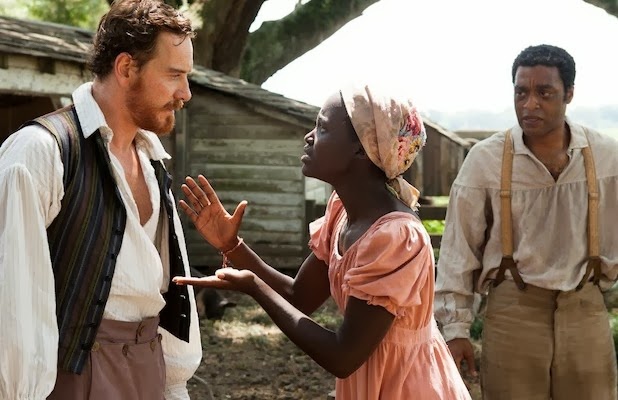
Yes, it’s worth noting that despite the strong male focus of the commercials and really of the plot, women represent probably the most interesting dynamics of the movie.  In a role that’s getting her raves, though I’m not quite as onboard as the rest of the world, Lupita Nyong’O plays Patsey, the favorite of Mister Epps both in her work and in his bedroom.  Though it’s well known that white men had affairs with their slaves and carried on more publicly than it’s assumed relationships with them, watching the nauseating horror of Patsey’s life causes you almost to stop breathing at some points.  She lives a life where she is worked to the bone, constantly raped by her master, and is subjected to psychological and physical torment by her mistress (American Horror Story’s Sarah Paulsen).  The scene that most people will recall of her plot is the violent whipping she receives at the hands of both Solomon and Epps late in the film, but the violent scene that sticks out to me even more is when Patsey, seemingly out of nowhere, had a heavy glass decanter thrown in her face by Mistress Epps.  The thud and the horrible lack of reaction for Patsey catches the entire audience (this is a movie with a lot of audience reaction) reaching for their chests.

Solomon’s plights follow a mildly more traditional route, and Ejiofor’s performance could be called the same.  He never loses the focus of his freedom, and quickly learns the best way to move ahead is to be in the background of his life as much as possible.  While his torment was excruciating to watch, the benefit of time shows me that I just didn’t connect with his work like I did some of the others.  I think it may be that he gets the least developed character of the bunch, or at least the one who changes in the most expected ways.  Patsey and Mister Epps go in dark and wicked directions during their story arcs, but Solomon has to bare the curse of the hero, particularly one who is drawn from real life-no one likes a saint, and no one can really make a saint interesting-this is what Ejiofor is stuck with, and while the audience rightly pities his situation, I just never found myself in the same connection with him as Patsey, perhaps because I knew his fate before the film began.

The movie succeeds when it gets to the most desperate and unexpected places.  It’s odd to think of this in comparison to McQueen’s recent (and, I have to say it, better) movie Shame, but both films are at their most fascinating when they go on in a way you didn’t think they would.  The scene, for example, where Solomon, trying to escape, happens upon a lynching in the woods, would normally be an escape scene or a pivotal moment to the plot-instead, it’s just something that he passes through.  We feel the fear of what will happen to Solomon, but McQueen gives us something more interesting-a slice of the fear he would experience every day.  It’s a great observation of how there was no escaping the constancy of his melancholy-the film doesn’t let up, and when it does, it doesn’t give the audience relief.

In addition to this scene, there’s perhaps the best moment in the movie, when we get probably the strongest performance of the film, even though it lasts roughly four minutes.  Alfre Woodard was featured with no prominence in the commercials to this film as Mistress Shaw because she is hardly in the film.  However, her scene is so odd, so strange, and so filled with an undercurrent of malice that I have to call it my favorite.  Mistress Shaw is a slave that doesn’t live as one-she has become the de facto wife of one of the overseers, and is trying to encourage Patsey into such a life.  She lives her life away from all of society, but doesn’t suffer the beatings and torment that Patsey and Solomon do in their lives.  Woodard, though, finds the guardedness in this character-she spends most of this scene sizing up Solomon, trying to figure out whether he poses a problem to her or how he can assist her.  Though her life seems ridiculous (sitting around in large southern dresses on a porch getting served tea in the middle of the backwoods), she knows this is the best possible outcome to her existence and isn’t about to relinquish it.  None of the other big-name actors in the movie that show up for the briefest of moments (Paul Dano, Benedict Cumberbatch, Paul Giamatti), are able to maintain a lasting impact on the audience, but Woodard not only does this, I have found myself thinking about the enigma of her character far, far longer than her actual screen-time.

The film is destined to be a major player in the Oscars, and quite frankly may end up the winner of the Best Picture Oscar, but like The Hurt Locker a few years ago, I’m impressed but not in love.  There are moments like the Mistress Shaw scene where I have to step back and truly admire what a consummate filmmaker McQueen has become in such a short filmography, but overall I have to give it my back-handed compliment of “handsome.”  There’s nothing wrong with the film, but in its way of trying to provide both realism and truth to the real-life Solomon, it sacrifices the unexpectedness and the unpredictability that makes a truly great movie so unique.  There’s no weak elements, but calling it the best just doesn’t seem to be the proper reward for when McQueen hits a triple and everyone calls it a home run.

The film is quite long, and I’m guessing anyone who has seen it has an opinion, so it’s time to share yours-what did you think of the film?