Showing posts with label Michael Stuhlbarg. Show all posts

Wednesday, July 15, 2020

Shirley (2020)

Film: Shirley (2020)
Stars: Elisabeth Moss, Michael Stuhlbarg, Logan Lerman, Odessa Young
Director: Josephine Decker
Oscar History: No nominations
Snap Judgment Ranking: 3/5 stars

All right, so we're continuing our week-long look at the movies of 2020 with a second film that played at Sundance (the first was Monday's Palm Springs), Shirley.  The movie, purchased by Neon, seemed destined for the sort of critically-acclaimed (but brief) summer run that such movies oftentimes get.  The film got raves, and falls into the weird glut of movies that Elisabeth Moss has been choosing to excel in since Mad Men went off the air.  She's taken on key roles in mainstream flicks (Us, The Kitchen, The Invisible Man), but by-and-large she's just been acing work in really low-key independent cinema, in some cases movies you might not have even have heard of despite her celebrity (Mad to Be Normal, Light of My Life, The Free World, Chuck).  Here, she plays what could be one of her most memorable roles as legendary horror writer Shirley Jackson.

(Spoilers Ahead) The film is told over the course of one school year.  We have a young couple Rose (Young) and Fred Nesser (Lerman), who are staying at Bennington College with Stanley Hyman (Stuhlbarg) and his wife Shirley Jackson, who has recently written the critically-acclaimed (but deeply controversial) short story "The Lottery."  Jackson doesn't conform to the role of a professor's wife naturally.  She's abrupt, curt (frequently crossing into rude), and discusses sex in a way that other people simply don't do in the 1950's.  She starts a strange friendship with the pregnant Rose, messing with her head, but still seemingly liking her in the only way Shirley can express...all the while tormenting herself with a new novel that she refuses to let her husband read.  As the film unfolds, we begin to see the complicated dynamic between Shirley & Stanley, and the way that the Nessers' relationship covers for a less than idyllic marriage.

This is not an easy film, and certainly not a straight-forward biopic.  It takes place for a just a year, while Jackson is writing one of her novels Hangasaman (a book that is celebrated, but not something that you could instantly name-check in the same way you could something like "The Lottery").  Hangsaman was based on the real-life disappearance of Paula Jean Welden, who attended Bennington college and who the real-life Jackson doesn't appear to have met, but her husband may have when she attended the school.  This murderous nature of a real-life crime hangs over the film in the way that we see fictionalized versions of real-people, and Jackson's paranoia & fits of mad genius leave us questioning everything we see.

This generally works, though it's hard-to-watch.  The movie is doused in heat, a sticky sweat over all of the actors.  The film frequently shows the Nessers in some throw of sexual desire (though it's worth noting that this is not an equal opportunity nudity situation, as Young is forced to be far more exposed in these scenes than the more-famous Lerman), and it always feels hot, and not in the double entendre way.  The movie perhaps doesn't always have a firm enough script to carry its plotting, and some of its twists feel a bit arbitrary (either they were telegraphed an hour earlier or feel like an unnecessary distraction), but it's watchable thanks to Moss in the central role.  She's extraordinary as Jackson, finding menace with a playfulness that makes her Shirley feel like a demonic, overly-talented child.  She plays her scenes knowing that she wants things from others, but confident that she's better than everyone (and has the talent to prove it).  It's the kind of work that when Moss inevitably starts scoring frequent Oscar nominations we're going to point to as evidence that she could pull off such a performance all along (like Julianne Moore in Safe).

Saturday, November 30, 2019

Oscar's 15 Biggest Snubs

We're in the heat of Oscar season, and as someone who has been writing about the Oscars for seven years straight on this blog, I have written a lot of things about the Academy Awards.  I don't have access to insider information about the Oscars (even in an era of everything being on social media almost instantly, there's still something to be said for interviewing theoretical nominees or attending press events), so it's occasionally a slight challenge to come up with unique things to say about the Oscars, especially since we spend so much time in the past here and have done so many trivia articles through the years (plug time: if you're newer to this blog, peruse the tags on the side, especially "Lists" and "Official OVP Ballot" if you want to look at hundreds of different dissections of past Oscar races).

So color me surprised when I realized I've never done a list of the biggest Oscar snubs of all-time.  It's hard to corner down the biggest snubs ever in Oscars history, so we're going to focus today on the acting races, and a Top 15 list of performances.  This is obviously subjective, but below are the 15 best performances ever that I think most definitely should have been nominated for the Oscar, and in most cases, should've won the statue.

A couple of notes before you dive in.  First, you'll notice I don't repeat any movies, and that's on purpose.  A few of these films didn't get any Oscar love in any category, and so it'd be easy to put the entire ensemble on this list, but that'd be boring (I tried, and failed, to not duplicate actors as one person gave two performances I refused to ignore).  So Kim Novak or Charles Bronson, I see you and I'm sorry-know you'll also be nominated when the time comes.  Second, there are more men than women on this list, but that has less to do with qualitative dissections of film, and more to do with me agreeing more often with the Oscars on female performances than male.  And lastly, these are old movies.  While I could just as easily have come up with a list of 15 performances from the past decade Oscar should have noticed (and might well do that if I do any "Best of Decade" lists next year), only a couple of films on this list I think have had enough time to breathe for me to realize that they're "indisputable snubs."  With that said, dive in and fight me in the comments!


15. Andy Griffith (A Face in the Crowd)

A harrowing look at a man the world wants to just be simple, but instead is a malevolent, cruel creation, only someone who could portray "sweet as pie" like Andy Griffith could shock us all as Lonesome Rhodes (the obvious correlations to Trump 50 years before he'd become president are indisputable & petrifying).


14. Rita Hayworth (The Lady from Shanghai)

I wrote once that Rita Hayworth is the greatest actor of all-time to never be nominated for an Oscar, so you knew she'd show up here.  Her Rosalie is an enigma, the kind of woman that drives men mad...and while they're entranced she gets exactly what she wants.


13. Michael Stuhlbarg (Call Me by Your Name)

Yes, he should have gotten in for the speech alone.  But the speech wouldn't work without his subtle groundwork beforehand, watching his son endure love-and-loss in the same summer.  Stuhlbarg has been a reliable character actor for a decade now, but has never been so tender as CMBYN.


12. Orson Welles (The Third Man)

Harry Lime is everything we came to expect from Orson Welles.  Possibly the greatest actor of his generation (give or take Brando & Ingrid Bergman), Welles brings a devilish charm to Harry in The Third Man, almost making you forget that he's been gone for half of the picture, and once you realize what he's been up to, you understand why "devilish" is the right term for Welles' work.


11. Cary Grant (The Philadelphia Story)

Jimmy Stewart is a fine actor and lovely in The Philadelphia Story.  He's also giving the third best performance in the movie.  The best work in the film wasn't even nominated, with Cary Grant giving the finest acting of his long career, playing the most "Cary Grant" role ever, and defining the suave, delicious persona that would keep him a star for decades.


10. Marcello Mastroianni (8 1/2)

When I sit down with cinephiles, few directors inspire more argument than Fellini.  Hell, put me in front of a mirror and bring up Fellini, and I'll argue with myself.  But I will stand no assertion that 8 1/2 isn't perfect, and no performance in his filmography is as effective as Mastroianni's, breathing life into his wandering director.


9. Jeanne Moreau (Jules and Jim)

The two title characters can easily be pushed aside, because for anyone who has seen this movie, there is only Catherine.  A picture of romance, drama, comedy, and at parts even horror, Jeanne Moreau became one of the indisputable faces of the French New Wave with this gorgeous, chaotic free spirit.


8. Anthony Perkins (Psycho)

Perkins work in Psycho so often features on these kinds of lists, it borders on cliche.  But how do you deny such a fully-realized creation, a monster whose evil is easy to identify, but impossible to forgive?  Every detail in his performance comes to light with clarity upon repeat viewings, but you are still shocked by Norman's plans thanks to his handsome uneasiness.


7. John Wayne (The Searchers)

Anyone who says John Wayne can't act needs to watch The Searchers.  John Ford's magnum opus also puts the Duke in his most challenging and effective role, Ethan Edwards.  Wayne finds the heart in a cruel, inhuman (but all-too-real) man, wandering through the desert until he no longer understands what he's looking for...perhaps his own soul?


6. Katharine Hepburn (Bringing Up Baby)

Kate Hepburn was hardly at a loss for Oscar nominations-she was cited 12 times, and won 4.  That said, it still feels weird that the best thing Hepburn ever did in her career, her kooky Susan in Bringing Up Baby, somehow didn't get her nominated.  In the same year as her classic Holiday, was the Academy just not ready to admit they had a crush on the actress yet?


5. James Stewart (Vertigo)

If Cary Grant's going to take Best Actor in 1940, one could make a sincere argument that Jimmy Stewart should have won later for his Scotty Ferguson.  Vertigo was a financial disappointment, which is still no excuse for skipping the best work of this actor's career, as a man driven insane by lust, then heartbreak, and then just madness.


4. Brad Pitt (The Tree of Life)

Terrence Malick is always the star in a Terrence Malick picture-that's what the world-famous actors who sign up for his films are aware of when they take the job.  That said, Brad Pitt still manages to give one of the best auteur vessel performances I've ever seen as Mr. O'Brien, a man who would haunt his son's adulthood for decades in ways he couldn't understand.


3. Orson Welles (Touch of Evil)

Giving Stewart a run for his money is the other grand teton of 1958's Best Actor category, Orson Welles (I swear that's not a fat joke).  By this time Hollywood had no use for the former Boy Wonder, but that didn't stop him from making a movie like Touch of Evil, essentially the Unforgiven of film noir-his racist, corrupt detective pulled the mask off of what was lurking behind the Golden Age's treatment of the genre.


2. Henry Fonda (Once Upon a Time in the West)

Imagine casting Henry Fonda as a villain.  Nwo imagine him as a vicious man in black, with those piercing blue eyes staring down on a horrified Claudia Cardinale, and a ticking clock western where it's so well-structured you genuinely don't know who is getting out alive.  In a career where Oscar rarely called, this is Fonda's best work and more than earned him a trophy.


1. John Huston (Chinatown)

Huston's performance in Chinatown may be the best Supporting Actor performance, period.  His Noah Cross is a villain for the ages, able to conceal under his peculiar vocal cadence unmitigated evil, and justification for that evil as the movie unfolds.  Look at him, his head always turning, even as the credits role-Huston dazzles in Chinatown as if acting was what he was born for.

Friday, January 12, 2018

OVP: The Shape of Water (2017)

Film: The Shape of Water (2017)
Stars: Sally Hawkins, Michael Shannon, Richard Jenkins, Doug Jones, Michael Stuhlbarg, Octavia Spencer
Director: Guillermo del Toro
Oscar History: 13 nominations/4 wins (Best Picture*, Director*, Actress-Sally Hawkins, Supporting Actor-Richard Jenkins, Supporting Actress-Octavia Spencer, Cinematography, Costume Design, Film Editing, Original Score*, Production Design*, Sound Mixing, Sound Editing, Original Screenplay)
Snap Judgment Ranking: 3/5 stars

My relationship with Guillermo del Toro is not uncomplicated.  The first film I ever saw of his was Pan's Labyrinth more than a decade ago, and I loved it.  It was one of my favorite movies of 2006, and I remember being in awe of the magical realism of the picture, and the way that it engaged an enchanting fairy tale with a grim reality in Franco's Spain.  But the years since have worn on this relationship.  I thought the Hellboy movies were mediocre at best, frequently trading on the "I'm a freak, but I'm beautiful" message a little bit too hard.  Crimson Peak was what used to be called a "hot mess," and Pacific Rim's most important contribution to cinema was this.  As a result, I went into his most critically-lauded picture since Pan's Labyrinth with some modulated trepidation.  The trailer was beautiful, the actors in it felt like they would fit del Toro's world but not be overwhelmed by it, and I was ready after a hard year to invest a bit more fully in a complicated fairy tale.  Unfortunately, while it's lovely to look at and has its moments, The Shape of Water continues the trend of movies I'm more indifferent to than swept away by when it comes to del Toro's cinematic output.

(Spoilers Ahead) The film centers upon Elisa (Hawkins), a mute janitor in the 1960's, working at a secret research facility at the height of the Cold War.  She lives a staid life, marked by routine (polishing shoes, hard-boiled eggs for lunch, and because this is a del Toro film, morning masturbation in the bathtub) and quiet friendships with her aging gay neighbor Giles (Jenkins) and her fellow, chatty janitor friend Zelda (Spencer).  One day, a new creature, played by Doug Jones (kind of similar to what a mermaid would be if it were 50% fish, 50% human, but if it was your whole body), is brought in by a sadistic colonel (Shannon), who takes a perverse shine to Elisa and enjoys torturing the creature.  The film unfolds with Elisa falling in love with the creature, trying to free him while the colonel is out to destroy him, and increasingly dominate her.

The movie functions as yet another strange fairy tale, and like most of del Toro's films, there are moments of visual splendor that are undeniable.  The magical realism is occasionally ridiculous (that entire sequence where they're floating in the bathroom defied physics in a way nothing else in the film does), but it's lovely to look at, and the sunset scenes are gorgeous.  The movie, though, suffers from too much plot, and performances that are all-over-the-map (okay, just Michael Shannon).  As the colonel, an actor who is rare on subtlety (and really has an imposing physical demeanor that doesn't allow for such things), his increasingly manic portrayal of a deranged and unhinged colonel is too much for even a film that suspends reality so frequently, and toward the end his cartoonish villainy has totally subsumed the picture.  Combined with a confusing performance from Michael Stuhlbarg (who can blame this more on the screenwriters, who make his motives nearly impossible to discover and his character resolution is left bloody on a pile of sand...literally), the film's plot is too sloppy for my tastes.

The rest of the performances fare better.  Spencer is such a winning screen presence she fares the best with this complicated material, giving Zelda a worn warmth that I responded toward.  Hawkins is getting the lion's share of the plaudits, but while it's a physically demanding role, I have to admit I wasn't as drawn to this work as I suspected I would be.  Her character is interesting, but she doesn't sink in the way you'd expect during the tougher scenes, particularly when she goes quickly from self-sufficiency and self-pity and back again.  And with all due respect, Richard Jenkins is not convincing as a gay man.  His plot is equally tragic to Elisa's, perhaps more so because he's left with nothing in the end of the film, but the script doesn't really care about that, and it feels an awful lot like the "sassy gay friend" trope in a film that has a pretty strong queer narrative otherwise.

All-in-all, I left unimpressed even if there's obviously something fascinating there.  Del Toro's going to continue to demand my ticket money if only because his visuals are too interesting for me to skip out (plus, he may well be headed to his "Oscar-friendly" phase after The Shape of Water), but I think that if this film can't get me to amour once again, I doubt I ever will for anything other than Pan's Labyrinth from his creative mind.

Monday, December 25, 2017

OVP: Call Me By Your Name (2017)

Film: Call Me By Your Name (2017)
Stars: Timothee Chalamet, Armie Hammer, Michael Stuhlbarg
Director: Luca Guadagnino
Oscar History: 4 nominations/1 win (Best Picture, Adapted Screenplay*, Actor-Timothee Chalamet, Original Song-"Mystery of Love")
Snap Judgment Ranking: 5/5 stars

I have been avoiding for nearly two months spoilers regarding Call Me By Your Name with alarming success.  I shall save for another day my disdain for release schedules and the fact that Twitter needs to find a way to better respect that not everyone lives within ten miles of Beverly Hills or Time Square, but this past Friday I FINALLY got to see the movie I have been hearing such extraordinary buzz about for months now, and see a film that, just a year after Moonlight, is somehow still getting Best Picture consideration even though Oscar "already honored a gay movie."  Thankfully, the hype was not only lived up to but exceeded my expectations-Call Me By Your Name is a remarkable achievement, and truly a special piece of cinema.

(Spoilers Ahead) The film centers on Elio (Chalamet), a Jewish-American young man of about 17 (did they actually say his age in the film, or is this just plucked from the novel?), who is annoyed with his father's (Stuhlbarg) research assistant, a grad student named Oliver (Hammer) who is working on an archeological dig.  The film starts with the talented Elio largely disliking the casual, relaxed Oliver, and then slowly realizing that his feelings of disgust are masking a deep attraction that they both feel for each other.  The movie wanders through this relationship, frequently hitting anticipated pitstops but never entirely giving into cliches the way one would assume such a film about self-discovery, forbidden sexuality, and love would unfold.

It's hard to know where to begin with the film, but I'll perhaps confess first that I was crying intermittently during the final twenty minutes (less than I had expected considering how moving it was) and then when I turned the engine on in my car in the parking garage, I felt a wave of raw emotion sweep me over and began sobbing uncontrollably.  Perhaps this is because Call Me By Your Name derives its masterpiece status from not being a movie with easy answers or simple questions.  The writing is momentous, with crisp, fresh dialogue, and gives you great ideas about how quickly life moves and how we don't always recognize what matters when it happens.  Michael Stuhlbarg gets an astounding monologue toward the end of the film where he tries to impress upon his son not that he will have other lovers, but more so how rare what he just experienced is, and how it gets harder to love so freely and with such abandon as we get older, so appreciate it and don't bury or cheapen the emotions he's feeling.  The line "We rip out so much of ourselves to be cured of things faster than we should that we go bankrupt by the age of thirty and have less to offer each time we start with someone new."  I genuinely can't remember the last time a movie I saw had such a profound pearl of wisdom buried within it.

But Call Me By Your Name is filled with jewels.  It's occasionally funny (though attention straight people-if you're the only person who is laughing, or clearly only straight people are laughing about the behaviors of gay characters, you're being homophobic-there was a woman who kept nervously laughing in the film during scenes that were a lot more serious than she assumed them to be, and it was bordering on a hate crime by the end of the picture), and I liked the beats of giving the characters more happiness than we're conditioned to assume in a gay-themed romance.  The movie's score is fantastic, littered with interpretations of classic composers, and enriched with several songs by Sufjan Stevens, who has crafted arguably the most unique-to-its-picture original soundtrack I can remember for a non-musical since The Graduate (the similarities with Mike Nichols' classic abound, and other than maybe Richard Linklater's Before Sunrise, the 1967 picture is Call Me By Your Name's most obvious spiritual sibling).  And James Ivory's traditional class and stiff-then-relinquished view on love in movies is a natural fit for this story (and whomever was the person who nixed the narration idea that was apparently central to the novel deserves an Oscar by themselves-the genuine question that hangs over whether or not Elio or Oliver stay together drives the picture, with you assuming they don't but praying they do).

The film's performances, though, seem to be gaining the most attention, and with good reason.  Hammer has never shown this sort of ability before, and plays a man enjoying perhaps his only dalliance with a sexuality he's been taught to repress (he becomes engaged to a woman at the end of the picture, and shares that his father would disown him if he were to continue dating men) with great relish.  There are scenes of intimacy between the two that show Oliver starved for affection, a part of himself he shut off finally getting a day-in-the-sun.  Stuhlbarg has a smaller role than I assumed based on reviews, but is so devastating in his final monologue that it's easy to see why he's gained his plaudits-honestly, there's so much heartbreak and tenderness in that scene, it's impossible not to see more in every previous interaction his professor has with side characters, or really to see more in how you yourself see the world.  But most impressive of all is Chalamet, largely unknown before this year, who gives a master class in acting.  His work is so lived-in, it's as if he was being followed around an Italian villa and discovering his own world as he's going.  The final credits scenes, where he weeps into the fireplace, is sublime and the sort of moment actors dream about, but really there's nothing false in this performance, it's so self-assured.  Considering how tricky it could have been (it's easy to see a different actor making him too angry or too horny or too sad), Chalamet's Elio is a miracle.  I've been shocked all season that a 23-year-old man could gain love in the Best Actor field, but after watching the movie, it's a mystery no longer.  This is a performance too good to be ignored.

I may be gilding the lily here, but I'm coming back to this review having tinkered with it four times and not being able to quite get across how emotional and stunning the film was for me personally.  I get this way with select movies where I can't put it down, like when you read a book and then instantly have to reread it because you don't want the high of a great story to end quite yet (I did this at least twice with On Chesil Beach, and read it every April because its final moments are so powerful to me).  Before Sunset, The Conformist, Lost in Translation, Nashville, Titanic-movies that I just want to keep recapturing that bliss of seeing something so spellbinding onscreen, trying to understand why it filled me so fully.  I literally cried again this morning when I started playing Sufjan Stevens' "Mystery of Love" in my car.  Really great film can affect you in ways you didn't expect, and Guadagnino's picture is the sort that will stay with me for weeks after, the sort of movie you watch and decide to live your life differently.  I'm trying really hard not to be hyperbolic here, mostly because I hate it when people are hyperbolic about movies (perhaps because the movies they wax on about feel pretty run-of-the-mill for someone who has seen over 50 calendar-release films in 2017 alone this year, not to mention dozens of others that I see in my living room), but I can't help it.  I keep thinking back to Chalamet's face and the briefness of Elio and Oliver's encounter.  Call Me by Your Name is the closest I have come to love-at-first-site at the theaters in a long time.  I'm a bit scared to see it again because how can it be so good upon revisit, but based on my experience my gut rarely gives in like this unless the love is going to be permanent.  Anyway, I'm going to end it there, just flummoxed how the movie I have spent the past year hoping to see with sky-high expectations still said "yeah, John, we're going to be better than that."  And with that indulgent final paragraph, I am going to go listen to "Visions of Gideon" and daydream about Italy some more.

Thursday, December 01, 2016

OVP: Arrival (2016)

Film: Arrival (2016)
Stars: Amy Adams, Jeremy Renner, Forest Whitaker, Michael Stuhlbarg, Tzi Ma
Director: Denis Villeneuve
Oscar History: 8 nominations/1 win (Best Picture, Director, Cinematography, Film Editing, Production Design, Sound Mixing, Sound Editing*, Adapted Screenplay)
Snap Judgment Ranking: 5/5 stars

The films of Denis Villeneuve have been a hodgepodge for me, and not necessarily in a bad way.  The first of his films that I saw I was enamored with, enough to give Incendies my OVP from that year.  The next two of his pictures I caught, however, I left less-than-impressed, but mostly frustrated because I found elements of them so good.  Villeneuve starts a conversation in his films-he isn't afraid of tackling tough subjects and of giving us heroes that are deeply flawed, but my problem with him always lies in the way he can't quite go there with the ending for his characters, always giving them some moral ways out of hairy, tough situations (he has yet to approach the nasty genius of Dan Gilroy's Nightcrawler, even if that feels like a movie he might have made).  With Arrival, he takes his style and directorial work into a different direction, and so my question was-can the genius he clearly has be grounded enough by looking in a different direction to finally have me unequivocally proclaim one of his English-language films a masterpiece?

(Spoilers Ahead) Arrival has that same level of frustration, but unlike Prisoners or Sicario, he actually sticks the landing, making this his best movie-to-date.  The film reads, on-paper, as somewhat traditional.  You have Louise Banks (Adams), a linguist with past experience with the CIA, telling two separate stories, one of her daughter, lost to a rare disease as a child, and one of an encounter with an alien species, and humans trying to find a way to peacefully communicate with the species, with different parts of the world coming together with differing viewpoints (war, peace, something in-between) on how to handle the aliens.

This is a pretty conventional story, and in a lesser director's hands, perhaps it would have stayed solely on that question of "are they good or are they bad?", but Villeneuve is too interesting in his approach to film to stay entirely on that question.  We see, relatively quickly in the film (for me, at least) that time is a bit loose; I was able to tell fairly early in the picture that the "flashbacks" to her daughter were actually her in the future, and that would mean that she would live past this encounter, and humanity would continue.  This may be the most frustrating aspect of the movie, in my opinion-waiting for a twist you know is going to come is agonizing in a lot of pictures (just ask anyone who's seen most of M. Night Shymalan's later work).

But Villeneuve actually finds a way to make this work for him, particularly aided by a mesmerizing performance from Adams in the central role.  He uses her passive voice and demeanor to instill in us a sense of calm, but also defeatedness.  Villeneuve's problem is penetrating an audience that is fearful of worldwide catastrophe at any moment, and finding a way to connect with them without getting an eyeroll from an increasingly jaded public.  He does that by making this hard-it's not an easy film, and very few answers are spelled out in front of us.  He trusts Adams in the central role as our ambassador to these creatures, and to trying to find a strength to be beyond ourselves, a struggle that is as difficult for an audience member as it is for Adams on the screen.  Adams smartly doesn't give you a lot of heart in her performance-she is someone who has based much of her life on a few core beliefs, and her job-but she still finds wonder through an introverted, closed-off human being.  It's a marvelous look at joy and pain, but more the former which is truly a unique way to approach a film that essentially boils down to, "would you be willing to have the worst moment of your life wiped away if it also took with you some of the best?"  The answer is of course what you'd expect from a movie (have the daughter you know will someday die), but the way that Villeneuve gets there, placidly, calmly, but with great thoughtfulness is beautiful.  Arrival is his Birdman-where all of his ticks as a director find exactly the right spot to come together, and as a result we get something illuminating.

Tuesday, December 15, 2015

OVP: Trumbo (2015)

Film: Trumbo (2015)
Stars: Bryan Cranston, Diane Lane, Helen Mirren, Louis CK, Elle Fanning, John Goodman, Michael Stuhlbarg
Director: Jay Roach
Oscar History: 1 nomination (Best Actor-Bryan Cranston)
Snap Judgment Ranking: 2/5 stars

I almost didn't see Trumbo, but thankfully considering the place it has taken in the Oscar race I managed to catch the film out of morbid curiosity.  It seems strange, in hindsight, that we didn't see the writing on the wall here, as the film is about Hollywood's favorite subject: itself.  Chronicling the lives of the Hollywood Ten and the way the Blacklist cast a pall on the movie industry is something that AMPAS probably wants to put its two cents on retroactively, particularly considering that they played a pretty interesting hand in the original blacklist controversy, specifically in the case of our title character of Dalton Trumbo.  The problem is that the film, even with an interesting subject and a robust cast of fine actors, is that it is too staid, traditional, and not particularly good, which is a pity because it's about to be a dominant conversation piece in the awards season.

(Spoilers Ahead) The issue with the film is, as I stated above, not the subject, as the story of Dalton Trumbo was kind of made for the silver screen.  A prominent screenwriter and author, he went from being the toast of Hollywood, writing blockbuster after blockbuster, to being denounced as a Communist, and then eventually serving a prison sentence for Contempt of Congress.  After that he couldn't get hired to write under his own name, so he invented a bit of a mini-factory with his fellow blacklisted writers doing B-pictures for King Brothers, and despite being blacklisted still managed to write two Oscar-winning screenplays during the time with other names being fronts for the films (Roman Holiday and The Brave One).  His talent eventually brought to an end the blacklist when Kirk Douglas and Otto Preminger both revealed that Spartacus and Exodus were written by Trumbo, making the pretense that blacklisted writers weren't working ridiculous.

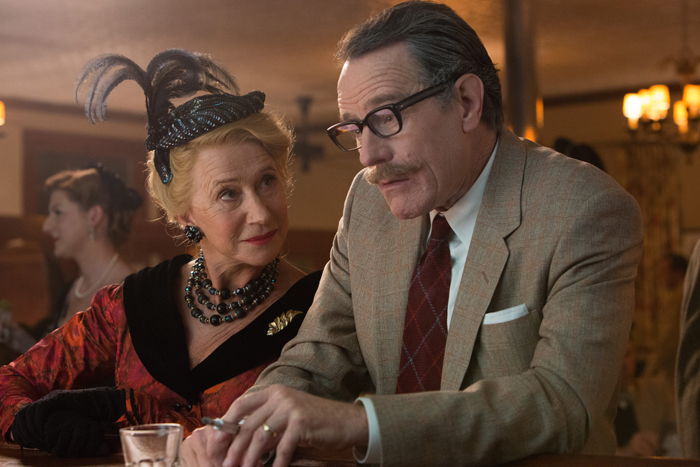
All of this is chronicled in Trumbo, and it's too enthralling and delicious of a story not to be occasionally entertaining.  It's a treat to see some of the random celebrity encounters, such as Michael Stuhlbarg's Edward G. Robinson and Dean O'Gorman's sexier-than-reality Kirk Douglas.  However, the movie is so dry and preachy that it doesn't feel as fun as it should be.  It doesn't help that Cranston can't find a lot of interesting things to say about Trumbo other than to make him a bit of a snarky saint, and most of the side characters are window-dressing.  Aside from the occasionally fun movie star impression, we have women like Diane Lane and Elle Fanning just standing there, revolving their entire world around Trumbo and doing nothing more than reflecting his drive.  On the opposite end of the spectrum is Helen Mirren, a talented actress who completely misgauges this role, making Hedda Hopper into a pseudo-fascist and even if that's true (Hopper was supposedly a horrible human being), it's hard to believe that she indulged in quite the scenery-chewing histrionics that Mirren puts her through, sinking every line as if she's landing a punchline.  Mirren's year, in fact, has been pretty poor between this and Woman in Gold, which makes her recent spate of awards success all the more puzzling.

The film also wants to exonerate Hollywood a little too ferociously, in my opinion.  While we get to see the devastation of what the blacklist did in particular to onscreen talent like Edward G. Robinson, it makes it seem that the film community, or at least anyone recognizable that isn't Hedda Hopper or John Wayne, was fine with the blacklist when clearly most of the community sat by and just let this happen.  This was, of course, wrong, but I would have preferred a little bit more insight into the minds of Hopper and her ilk to better understand the "why" behind this hatred, which is portrayed as simply a type of cartoonish villainy rather than gaining any sorts of human insights into their fear and paranoia.  This would have been a more interesting screenplay than simply one of a martyr, one that I suspect Dalton Trumbo himself would have better-appreciated.

Those are my thoughts on Trumbo, the film that apparently could when it comes to awards season.  What are yours-do you think Cranston or Mirren will be able to scoop up an Oscar citation?  Do you think they should?  And are you with me that this is a case of "interesting subject, boring execution?"  Share your thoughts below!

Sunday, October 25, 2015

OVP: Steve Jobs (2015)

Film: Steve Jobs (2015)
Stars: Michael Fassbender, Kate Winslet, Seth Rogen, Jeff Daniels, Michael Stuhlbarg, Katherine Waterston
Director: Danny Boyle
Oscar History: 2 nominations (Best Actor-Michael Fassbender, Supporting Actress-Kate Winslet)
Snap Judgment Ranking: 3/5 stars

I have an anathema to biopics, especially this time of year where the Oscars go gaga for them and I kind of want to throw up in response.  Seriously-they're so formulaic and so rarely say something interesting about the protagonist that history or the news media hasn't already discovered.  It's usually the same sorts of stories too, as frequently we see biopics of incredible human beings who accomplish feats against the odds (after all, who wants to see a biopic of just an ordinary human being?).  I went into Steve Jobs, though, a little curious.  After all, one of about four biopics from the past five years that I genuinely admired and loved came from Aaron Sorkin, writer of Steve Jobs, and was also about the Citizen Kane-style rise of a tech icon (in that case, Mark Zuckerberg and The Social Network).  Sorkin and director Danny Boyle don't disappoint in once again finding a new mold to fit the biopic in, but here we have a less successful execution thanks to a severely-botched third act that threatens to destroy an impressively-started motion picture.

(Spoilers Ahead) The film unfolds in three different acts, centered around the launches of a trio of products: the Macintosh, the NeXT, and the iMac, all of which left an indelible print on the world of technology but in wildly different frames of success.  The film follows Jobs (Fassbender) and his right-hand woman Joanna Hoffman (Winslet) as they encounter a series of interactions with various people in Jobs' world, including his Apple co-founder Steve Wozniak (Rogen), former Apple CEO John Sculley (Daniels), and his daughter Lisa.  The film watches as his relationships with all three change, and in some cases remain the same, with him constantly having a chilly distance to his daughter, revering Sculley as the father he had but apparently didn't want, and condescending Wozniak as a friend he needs to protect.  The film's third act addresses these years of interactions, when we know Jobs is about to translate from being a genius to becoming a sort of demigod in the world of technology, reinvigorating his company in a way that changed electronics and the world forever (not for nothing, but I'm writing this article on an iMac).

The film's framing device of these three launches is interesting, and keeps us from having to see a ploddingly simplistic look at how Jobs came from humbled roots (we get that hinted enough with the conversations with his longtime Apple co-founders), but it does occasionally come with issues.  For example, with the exception of Winslet most of the side characters end up being pretty two-dimensional.  Rogen's Wozniak, without a tale of how two such completely different men were able to create something so compelling, is just whiny and seems to hero-worship Jobs and yet despise him at once.  This may well be true, but the reality is that Rogen's performance isn't enough to make us comprehend that conundrum.  The same goes for Jobs' jerk attitude toward Lisa's mother Chrisann (Waterston)-the film treats her as a one-night stand that resulted in a baby, and we get little indication as to why Jobs was interested in her in the first place.  Fassbender's performance is remarkable, wonderfully-felt and delivered and really just a joy to behold as the titular character, but no one else around him seems to be of much use to screenwriter Aaron Sorkin.  I only recluse Winslet because she's so damn good at an underwritten character here (which, admittedly, is not what I'd call her strength).  Her Joanna is a woman who is so surface-level that Winslet does a remarkable job of inserting just enough moments of depth in her relationship with Jobs (whom you can tell she views a bit as the kid brother she never had and is constantly doting upon/scolding), though I would be remiss if I didn't point out that her accent-work needed some help.  These two are the best part of the movie by a country mile.

The writing is a conundrum for me.  I have long ago realized that Aaron Sorkin is an acquired taste, but occasionally even he needs to reign himself in, and his fast-talking, hyper-intelligent creations are frequently their own worst enemy.  Sorkin, despite his protestations, is not great at writing women (evidenced by the Winslet comments above), and in particular this shows with Jobs' daughter Lisa, who in the third act is unfortunately saddled with a series of mood swings that completely betray his previous precocious attitudes toward her (plus, no woman born in the tail-end of the Carter administration could spout a Judy Jetson-style zinger with that much ease).  However, the entire third act is a mess, with Wozniak, Sculley, and Lisa all coming to Jobs to try and gain absolution, and all are granted it by him with a handsomely-wrapped bow.  The reality is that this happens with almost no real indication as to why (after all, he had been on the cusp of a great new moment in technology multiple times before and failed-the character himself couldn't have known the iMac would revolutionize the PC), since he's still a prick who has purposefully prioritized his career over personal relationships and family.  The fact that Sorkin ended with a sloppily-tied-together "happy family moment" ending is appalling and cringeworthy, and really disregards most of his previous moments with Jobs.  The ending of this film, based on the first ninety minutes, should have little to do with his daughter and more to do with his professional vindication despite a constant barrage of personal failures.  The fact that the final scene is him lovingly looking at a girl he barely knows feels like something a studio executive demanded, but it reeks of lousy writing and a directorial choice beneath what Boyle/Sorkin pulled together in the stellar first two-thirds.

I hate poor endings to movies, and part of me wants to go with two stars just because the film left me with such a bitter taste in my mouth, but I'll relent and go with three based on the excellence coming from Fassbender and Winslet.  Overall, though, I left disappointed and wishing that the man who brought us something so extraordinary in The Social Network had better stepped up to the plate.