Showing posts with label Ruth Roman. Show all posts

Monday, December 30, 2019

Saturdays with the Stars: Season 1 Recap

Ida Lupino & Ann Sheridan, two of our
stars kicking their heels!
With yesterday's sojourn into the South Pacific, we have finished our first season of "Saturday with the Stars!"  I'm not much for naval-gazing (mostly because I am aware this blog is not read by swaths of people), but I am really, really proud of this past season.  When I came up with this idea, I mostly wanted to see if I could do it for a year, and with one exception (you won't be able to tell this unless you were paying really close attention because I pre-dated the article, but when I was suffering from a 103-fever & pneumonia, I published one article on a Sunday), I did!

This year has taught me about the careers of twelve amazing artists, and I hope you learned some things about them too.  I had never really done something like this with actors, focusing instead on genre or something arbitrary like Oscar nominations, but getting to see the progressions in these women's careers was eye-opening, noting the similarities as well as the differences in their journeys.  I am struck by how expansive the universe of classic film is still to me some 25 years after I first started to delve into it. This year we watched movies that I'd never even heard of until I included them in the project, and made a bunch of "deep cut" discoveries.

We'll begin our second season in a few days (click here if you want to learn more about it), but before we go I am a lover of lists, and wanted to rank a few of the movies we watched this year.  I'm appreciative to all of these actresses for the education & cinematic pleasure they gave me during this journey, so I'm only focusing on the positives (no "worst of" lists).  If you have enjoyed this series, please feel free to comment or tweet this post-I'd love to have more people joining us in Season 2.  And if you have opinions on these actresses (or further research I should do), share in the comments as well!

Favorite Performances from Each Star
January: Ann Sheridan-Woman on the Run
February: Virginia Mayo-Along the Great Divide
March: Cyd Charisse-The Band Wagon
April: Alice Faye-Hello Frisco Hello
May: Linda Darnell-A Letter to Three Wives
June: Lizabeth Scott-Too Late for Tears
July: Rhonda Fleming-While the City Sleeps
August: Ruth Roman-Lightning Strikes Twice
September: Esther Williams-Bathing Beauty
October: Hedy Lamarr-Ecstasy
November: Ida Lupino-The Hard Way
December: Mitzi Gaynor-Les Girls

5 Favorite Actresses of the Year (Alphabetical)

Linda Darnell
Alice Faye
Rhonda Fleming
Ida Lupino
Lizabeth Scott

5 Favorite Performances of the Year (Alphabetical)

Linda Darnell, A Letter to Three Wives
Alice Faye, Hello Frisco Hello
Ida Lupino, The Bigamist
Ida Lupino, The Hard Way
Lizabeth Scott, Too Late for Tears

10 Favorite Films of the Year (Alphabetical)

The Band Wagon
The Bigamist
Brigadoon
It's Always Fair Weather
Les Girls
A Letter to Three Wives
The Man Who Came to Dinner
My Darling Clementine
Strangers on a Train
Too Late for Tears

10 Favorite Performances of the Year in these Films (Not By Our Leading Ladies)

Humphrey Bogart, High Sierra
Kirk Douglas, The Strange Love of Martha Ivers
Nanette Fabray, The Band Wagon
Patricia Hitchcock, Strangers on a Train
Van Johnson, Brigadoon
Kay Kendall, Les Girls
Janis Paige, Silk Stockings
Ann Sothern, A Letter to Three Wives
Robert Walker, Strangers on a Train
Monty Woolley, The Man Who Came to Dinner

Saturday, August 31, 2019

Bitter Victory (1957)

Film: Bitter Victory (1957)
Stars: Richard Burton, Curt Jurgens, Ruth Roman
Director: Nicholas Ray
Oscar History: No nominations
Snap Judgment Ranking: 2/5 stars

Each month, as part of our 2019 Saturdays with the Stars series, we highlight a different actress of Hollywood's Golden Age.  This month, our focus is on Ruth Roman-click here to learn more about Ms. Roman (and why I picked her), and click here for other Saturdays with the Stars articles.

As we've stated throughout this month, Ruth Roman arguably had the shortest run as a leading woman in our series.  She enjoyed a brief run as a potential star with a Golden Globe nomination (for Champion), films with major directors (Alfred Hitchcock, King Vidor), and a Life Magazine front cover story.  By 1957, though, her career had largely been relegated to highly-billed but ancillary roles in B-pictures.  She wasn't even the top-ranked female star in a number of these movies, getting lower placement on the marquee than bigger names like Barbara Stanwyck & Virginia Mayo.  One could make the argument that her most well-known role post Strangers on a Train had been as the most famous person aboard the SS Andrea Doria, a luxury liner which sank in 1956, and briefly separated Roman from her son Richard before they were reunited (they had been on two different lifeboats).  All of this is to say that by 1957, getting to work with a director as consummate & celebrated as Nicholas Ray was a big coup for Roman, one that might have spelled a last chance for bigger stardom or even a "comeback" of sorts.  Alas, Ray's artistic side had other ideas.

(Spoilers Ahead) The film pits Captain Jim Leith (Burton) and Major David Brand (Jurgens) against each other right from the start.  Brand is a "model officer," someone who has used the military for prestige and uniformity, but doesn't have the experience as an actual soldier in the field that is required when a dangerous mission to go behind enemy lines into Benghazi during World War II emerges.  He therefore is forced to have Leith tag along for the duration (though he's under Brand's command), and he hates this-Leith is a rebel, someone who doesn't enjoy the strictness of the military and follows his own commands.  Both men are linked by their relationships with Jane (Roman), Brand's wife but Leith's former lover; Leith left her without explanation, and while the film has little need for such frivolity (this is not one of Ray's more romantic films), it's implied heavily that Jane never really got over Leith.  On the mission, it's proven that Brand cannot kill a German up-close, and his cowardice is seen by Leith.  Brand then uses his superior position to try and get Leith killed, eventually succeeding by not telling him about a scorpion that is nearby, which stings Leith and kills him.  In the process, though, his men essentially think that Brand is a murderer, and while he wins a medal, Jane can no longer stand him, and she leaves him realizing that his ego and jealousy caused him to kill the man she truly loved.

The film is bleak, which isn't an alien emotion for Ray, but it's definitely one that doesn't have the softness or tenderness that something like Rebel Without a Cause would have.  Roman's Jane is the only female character in the film, certainly the only one of consequence, and so it's mostly about the parlor games of men in power & wartime.  It's occasionally interesting to see a war film that's less about bravery and more about the emotional sacrifices that are required to fight in wartime, and how some people are not cut-out for death.  It's clear that Burton's Leith is intended to be the hero to Jurgens's villainous Brand, but honestly it's probably this aspect of the film that makes it age poorly and doesn't put it next to some of the truly great pictures that Nicholas Ray was able to create.  The lack of sympathy for Brand, especially initially when he simply cannot be the swaggering, Type-A man's man that Leith is, feels at odds with the rest of the film's "war is hell" motif.  Coupled with long stretches that are just boring (real talk: I am very hit-or-miss when it comes to enjoying Richard Burton onscreen), and you get a movie that is forgettable, not the sort of film like In a Lonely Place or Rebel where actresses like Gloria Grahame & Natalie Wood get parts-of-a-lifetime.

This is all to say that Ruth Roman didn't get her moment in the sun, and never really did.  She starred with famous directors and has a significant part in one undisputed classic, but her career is a fascinating study in what happens when a star simply doesn't land with the public, even when she has beauty to spare.  I wanted to take a look at Roman's career to see if there was something in her work that the public missed, a forgotten gem, but alas what I found was someone who couldn't elevate her material enough to warrant the careers of women like Grace Kelly & Ava Gardner whom she briefly counted as her peers.  Next month, we'll go to someone who was a proper (but quite distinctive) star whose run of success in the late 1940's kept one major studio afloat.

Saturday, August 24, 2019

Lightning Strikes Twice (1951)

Film: Lightning Strikes Twice (1951)
Stars: Ruth Roman, Richard Todd, Mercedes McCambridge, Zachary Scott
Director: King Vidor
Oscar History: No nominations
Snap Judgment Ranking: 3/5 stars

Each month, as part of our 2019 Saturdays with the Stars series, we highlight a different actress of Hollywood's Golden Age.  This month, our focus is on Ruth Roman-click here to learn more about Ms. Roman (and why I picked her), and click here for other Saturdays with the Stars articles.

We're going to cheat a little bit here in our profile of Ruth Roman's career by going back a few months before the release of last week's Strangers on a Train, but in a lot of ways this feels like a step in a different direction in Roman's career.  At this point, we've profiled three films where Roman had top billing, but she's never actually "been the lead" in any of the movies we've taken a gander at in these pictures.  Frequently Roman's career was marked by forays into westerns or noir, genres that usually have a main female role, but rarely center upon it.  This week, though, Roman actually gets to be the proper main character in our film (even getting to GASP act opposite other women!), and like Strangers, it's helmed by a man who would be cited for Best Director five times in his career.  This week, we come across the little-known Roman picture Lightning Strikes Twice.

(Spoilers Ahead) The film focuses on Shelley Carnes (Roman), a stage actress who is essentially trying to flee from her life.  After a grueling tour of Othello leaves her at death's door, she decides to go out to a dude ranch run by Liza McStringer (McCambridge) & her brother String (Darryl Hickman, in one of his few adult roles, and I believe one of the last roles before he joined a monastery), only to find that it's largely abandoned, as they no longer take on guests.  This is all happening in the shadow of a famed trial where Liza exonerated Richard Trevelyan (Todd), who was accused of murdering his wife (and most people assume he did, in fact, kill her).  The problem is that Trevelyan is living on a nearby ranch, hiding from his surrogate parents (whom he thinks killed his wife), and of course as he's the male lead, Shelley is going to fall for him.

The movie's second half is some batshit crazy melodrama, enough to make this worth checking out if you're a lover of the Douglas Sirk-style of filmmaking.  It turns out, of course, that Richard wasn't the killer (how else will he end up with Shelley in the end of the picture?), and it's not Scott's Harvey, who is a louse (which Zachary Scott characters aren't louses...see also our recent Roman picture Colt 45?), though there is a truly bizarre scene after Shelley turns down his marriage proposal where we're very much supposed to believe he's about to rape Shelley, even though all he's doing is reuniting her with Richard...if I missed something here, I'd love for you to tell me as I didn't understand what the hell was going on during that scene.  Either way, though, it turns out that mousy Liza was the one who killed Richard's wife when she found out she was having an affair with pretty much every other male character save her brother (and not for a lack of trying on his part), and has every intention of killing Shelley too, but doesn't, because she (and her brother) both go down in flames in a car chase just while Shelley & Richard, now exonerated, skate away to a happy life together.

The film's best element is its camp value.  McCambridge, one of the best supporting players of the era, brings it up to the rafters as Liza during those final scenes, chewing scenery as much as possible (I haven't seen it, but I've heard this is one of the more appealing aspects of putting her opposite another scene-stealer, Joan Crawford, in Johnny Guitar).  However, Roman doesn't really get much of the camp.  She's fun in this part-there's an amiability to her onscreen presence that's likable, but she doesn't really know how to land the movie against actors who understood the material better like McCambridge and Richard Todd (just two years after his Oscar-nominated work in The Hasty Heart, his career was already on the bit of the skids, and would need to go to Disney to play Robin Hood to continue keeping his name in lights).  Roman, as a result, shows that even with a central role in an interesting if not particularly strong picture, that she doesn't know how to elevate when she's made captain of the ship, instead being better as a supporting player.  Next week we'll conclude our look at Roman's career with a film from much later in her time as a leading woman, but in the meantime, share your thoughts on Roman so far in the comments, and if there's a crucial part of hers I've been missing in this series that might ignite more love for the actress.

Saturday, August 17, 2019

OVP: Strangers on a Train (1951)

Film: Strangers on a Train (1951)
Stars: Farley Granger, Ruth Roman, Robert Walker, Leo G. Carroll, Patricia Hitchcock, Laura Elliott, Marion Lorne
Director: Alfred Hitchcock
Oscar History: 1 nomination (Best Cinematography)
Snap Judgment Ranking: 4/5 stars

Each month, as part of our 2019 Saturdays with the Stars series, we highlight a different actress of Hollywood's Golden Age.  This month, our focus is on Ruth Roman-click here to learn more about Ms. Roma (and why I picked her), and click here for other Saturdays with the Stars articles.


When I selected Ruth Roman as our star of the month, one of the main reasons I did so was I wanted to see her most noted film, Strangers on a Train.  I didn't realize at the time that this would be a complicated decision in retrospect.  Roman's time on Strangers was probably a mixed one.  At this point in her (relatively short) career as a leading woman, she'd had a few hits (which we've profiled already here and here), and with this picture she was about to get her closest brush with immortality in what is generally considered to be one of Alfred Hitchcock's best pictures.  However, personally this was a rough shoot for Roman.  She and Hitchcock (who would never work together again) detested each other, with Hitch (after Jack Warner forced him to hire Roman, whom the director thought "lacked sex appeal") frequently harassing her.  Hitchcock was known for his intense, in some cases predatory, treatment of his leading ladies, and one wonders how much Ruth Roman liked being most associated with a film that was hell for her to make.  However, it is impossible to take a look at the career of Roman and not talk about Strangers, so here we are.

(Spoilers Ahead) The film centers on two men who meet by chance on a train (strangers, if you will): Guy Haines (Granger), a tennis star who in in a messy divorce with his cheating wife Miriam (Elliott), and who desperately wants to meet the classy senator's daughter Anne (Roman), and Bruno (Walker), a man who wants to kill his father so that he won't chastise him and will give him his fortune.  Bruno proposes that the two men "swap murders," solving both of their problems, and Guy politely laughs, thinking the man is just being morbidly silly, but in fact Bruno is serious, and takes this chuckle as an agreement to the bargain.  Bruno then does, in fact, kill Miriam (who has refused to grant Guy a divorce, ruining his chances at happiness), and the film unfolds with Bruno essentially blackmailing Guy into trying to commit the murder he didn't really agree to, all-the-while having planted enough suspicion on Guy that he might be able to pin Miriam's murder on the tennis player if he doesn't go along with the plan to kill his father.  The film ends with a chase on a carousel (which apparently didn't use as much trick photography as you'd think, which makes this scene one of the most literally dangerous you'll probably ever see in an actual movie, as a man climbs under an actual moving carousel), and eventually the police reveal, despite him lying with his last breath, that Bruno is in fact the killer of Miriam, exonerating Guy to marry Anne.

The movie is great.  I love Hitchcock in general, and so I was predisposed to this, but probably put it more in the camp of North by Northwest than a film like Vertigo or Notorious (I've never released my personal favorite Hitchcock list on this blog because I'd have to admit to not seeing a few classics, but this puts it right on the cusp of the 4-star brilliant ones and my 5-star beloveds).  Walker is sensational in the role of a lifetime (sadly, he'd die almost immediately after this film so it wasn't a movie that he could capitalize on), and Granger looks sexy as hell as Guy.  Obviously Anne is in love with Guy, but Bruno clearly is also (Hitchcock intended Bruno to be coded as gay, and it works-there's no confusing this for merely a brotherly swapped homicide), but who can blame him-Farley Granger in his tennis whites is the stuff that makes men realize their inclinations.  The film's plot has been so borrowed from that watching it for the first time nearly seventy years later likely doesn't have the same impact that it did in 1951 (you can't fault the movie for that, though-it's not its own fault it was such a landmark), the acting from the likes of Walker is timeless enough it's still sensational.

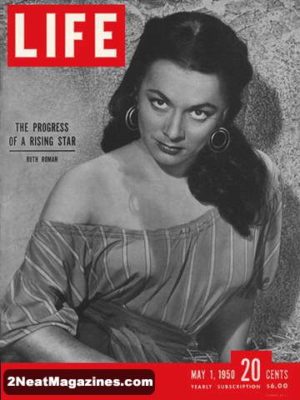
Roman, our star of the month, continues her curse of having top-billing for supporting parts, and she's good in the film, acting lovely and occasionally getting some interesting scenes (particularly one at the tennis match), but she's no match for her female costars.  Hitchcock's antipathy to her might have been because, for possibly the first time in his filmography, he gave the impossibly gorgeous woman the least interesting part in the picture.  After all, Strangers on a Train is brimming with great supporting turns for the ladies, from Elliott's vicious Miriam to Patricia Hitchcock's brainy-but-oblivious Barbara (proving that nepotism can occasionally advantage the audience) to Lorne's doting, enabling, and probably knowing mother-of-the-murderer.  Roman gets saddled with the love interest and doesn't really have enough script to stand out in a picture filled with standouts.  At this point, Life Magazine had proclaimed "The Rise of Ruth Roman" across its cover, but in looking at her key films of the era, we haven't actually seen her rise to anything other than the woman-behind-the-man.

Saturday, August 10, 2019

Colt .45 (1950)

Film: Colt .45 (1950)
Stars: Randolph Scott, Ruth Roman, Zachary Scott, Lloyd Bridges, Alan Hale, Sr.
Director: Edwin L. Marin
Oscar History: No nominations
Snap Judgment Ranking: 2/5 stars

Each month, as part of our 2019 Saturdays with the Stars series, we highlight a different actress of Hollywood's Golden Age.  This month, our focus is on Ruth Roman-click here to learn more about Ms. Roma (and why I picked her), and click here for other Saturdays with the Stars articles.


For film historians, when you think of Randolph Scott frequently collaborating with a film director, you think of his seven pictures in conjunction with Budd Boetticher, including movies like Seven Men from Now and Ride Lonesome which are considered classics of the western genre.  Scott, however, made a habit of working with the same directors over-and-over, and one of those men was Edwin L. Marin.  This was the sixth of nine films that the two men made together before Marin's death just under a year after the release of Colt .45.  Marin was one of those directors who simply stood as studio-for-hire being a contract player (but hardly what we'd consider an "auteur" like Boetticher would be considered among future historians), doing long stints at MGM, RKO, and at the end of his career, Warner Brothers.  Warner brought him in conjunction with Scott, and our star of the month, Ruth Roman, Colt .45's leading woman.

(Spoilers Ahead) The film focuses on Steve Farrell (Randolph Scott), a gun salesman who is trying to sell the new Colt .45 repeating pistols to a local sheriff, when suddenly there's a breakout at the local jail with Jason Brett (Zachary Scott), getting out, shooting the sheriff, and then framing Farrell for the crime as he leaves town.  Farrell is locked up for a few months before the new sheriff (Hale) lets him out because he believes him to be innocent.  He vows revenge & to catch Brett, and sets off to steal back his two Colt .45 pistols.  Along the way, he makes the acquaintance of a woman on a carriage ride (in the middle of a gunfight, because this is a western) named Beth Donovan (Roman) who is married to a seemingly blackmailed man named Paul (Bridges), who it turns out is actually fine with working for Brett despite his wife's disgust for the man.  The same can be said for the new sheriff, who is also working in conjunction with Brett (apparently everyone's corrupt that isn't above-the-title), and the almost laughably just Farrell has to go about eventually bringing all three men to justice (though Brett kills Paul in a moment of treachery because we don't want the widow who's going to be hankering for Farrell to get together with the man who shot her husband).

The film is not particularly noteworthy today (it's the sort of forgettable western that's on at 2 in the afternoon on TCM on a Wednesday), but it's interesting to look at from a few curiosity angles.  For starters, the movie is entranced by the title guns.  There's a title card that feels like it was written by a modern-day Republican senator at the beginning of the movie where it says "A gun, like any other source of power, is a force for either good or evil, being neither in itself, but dependent upon those who possess it."  The movie itself tries to prove this by having the evil men (particularly Jason Brett) do ruthless, unspeakable things with the guns and ultimately has one meet his match, while the impossibly honorable Farrell is a worthy possessor of the guns.  The film's glorification of violence is seemingly in-line with the times (violence was always a main staple of the western, and this is no exception), but that title card makes it feel a bit more sadistic as a picture-are all of the people that were killed by Farrell deserving of death, and those that aren't killed by him not?  That Brett kills double-crossing Paul (Lloyd Bridges, dressed in a cowboy uniform that feels more at-home in West Hollywood than the Old West) makes the title card seem like Paul didn't have it coming...but if that's the case, is it appropriate that his wife gets scooped up by the hero anyway?

Roman is good in what could have been a throwaway part as the woman in the center of all of this.  I got the feeling she didn't do most of her riding stunts, but the ones she did were impressive, and she brings a sharp fire to her scenes in the movie, particularly the ones with Jason Brett.  In many ways she resembles Maureen O'Hara, though she doesn't get as good of writing as the redhead did in her John Ford westerns, in that she feels like she belongs in this old west even though the story just wants her to be gorgeous.  The movie actually finds time for her toward the end, and there are moments where she isn't just a damsel-in-distress, but actually putting herself in danger that feel (on a sliding scale) somewhat feminist.  This is the second western that we've seen from Roman so far this month, and we'll return to at least one more before the month's end (with one of her most significant films), but it's easy to see here what Warner saw in her coming out of The Window and how, with Randolph Scott clearly the star, why her celebrity faded almost as quickly as it arose since it's hard to become a fan of her in such an underwritten part.

Saturday, August 03, 2019

Dallas (1950)

Film: Dallas (1950)
Stars: Gary Cooper, Ruth Roman, Steve Cochran, Raymond Massey, Barbara Payton, Leif Erickson
Director: Stuart Heisler
Oscar History: No nominations
Snap Judgment Ranking: 3/5 stars

Each month, as part of our 2019 Saturdays with the Stars series, we highlight a different actress of Hollywood's Golden Age.  This month, our focus is on Ruth Roman-click here to learn more about Ms. Roma (and why I picked her), and click here for other Saturdays with the Stars articles.


We start out our monthly focus on Ruth Roman with the genre that she was best known for: westerns.  As we discussed in our kickoff (see link above) to Roman, by 1950 (her first proper annum as a leading woman), she'd had a few years as a supporting player, and had had two big hits in 1949: The Window and Champion, after which she got a long-term contract with Warner Brothers, got the cover of Life Magazine proclaiming "The Progress of a Rising Star: Ruth Roman," and made a bevy of different films, including Dallas, our movie today starring Gary Cooper.  Like many first films in our Saturdays with the Stars profiles, Roman's role here is deceptive to her billing, with Cooper getting almost everything to do despite sharing the top of the banner with his young costar.  It's also, well, kind of an odd movie.

(Spoilers Ahead) The film focuses on Blayde "Reb" Hollister (Cooper, and yes, a moniker that could only exist in a movie), a member of the former confederacy who is such a believably good shot that even Wild Bill Hickok seems to have respect for him, whose family was killed by a group of Northerners during the war.  In the opening scenes, Hollister fakes his own death with Hickok's help, and swaps identities with Martin Weatherby (Erickson), a green-in-the-gills newly-appointed marshall who will surely soon die as he doesn't have the shooting skills or manner to take on such a job.  He got the role to impress his fiancé Tonia (Roman), whose family is being terrorized by the same family that killed Hollister's, the Marlows (headed by Massey's Will, a now "respectable" man who is still just as corrupt as ever).  As the movie unfolds, we see that Tonia is torn for her newfound lust for Reb, as well as her duty to Martin.

The film is odd in the sense that Martin never becomes a villain or ever even a proper adversary of Reb, even though he's clearly got designs on his girl.  There are moments, yes, where he basically hides Reb's papers that would exonerate him for a previous crime (freeing him up to marry Tonia), but there's not a lot of climax to that scene since it's obvious that he'll do the right thing, and he does so in quick succession.  He's certainly not the villain, as that's Massey's Will, a 1950's style nemesis as he's not only cold-blooded but also trying to be "respectable," something that as the decade would wear on would become something we'd see with more frequently-the bad guy who makes his operation legit.

Roman's part is small, as I mentioned above, but it isn't without interest.  Cooper at this point of his career had seen most of his leading man good looks, the kind that made him impossibly seismic back in the 1930's & 40's, start to fade so it's a bit unbelievable that a woman 20 years his junior would so quickly become enamored with a man who looks more like her father than her lover, but she makes the love triangle compelling.  The best part of the movie is that, while you suspect Cooper will get the girl (it's hard to imagine him letting such a thing as the final kiss slip through his contract negotiations), it's not clear the entire movie which guy Tonia will ultimately choose, and I kind of liked that for a western.  Tonia is not a great character, and I hope we'll see more from Roman as this series progresses, but she finds an intrigue in the character that I think someone else would have made one-note.  Honestly, though it feels like the sort of movie that would be easily glossed over in the filmography of an actor as important as Cooper (I don't think I'd ever heard of Dallas before picking it for this series), between the unusual plot beats, the undecided romance, the glossy Technicolor, and some fun side characters (particularly Barbara Payton's fiery "mob mol" trope-character), this isn't a bad way to spend an afternoon.

Thursday, August 01, 2019

Saturdays with the Stars: Ruth Roman

Each month of 2019 we will be looking at the careers of leading ladies of Classical Hollywood who were never nominated for an Academy Award as part of our "Saturdays with the Stars" series.  Last month, our focus was on Rhonda Fleming, the "Queen of Technicolor" during the 1950's.  This month we turn to arguably our most esoteric choice on the list, an actress who was briefly a headliner for Warner Brothers in the late 1940's/early 1950's, but save for one major motion picture, would be all but forgotten today despite being a regular presence in movies throughout the 1950's.

Ruth Roman was born to be in show business-her father was a carnival barker and her mother a dancer, and after attending drama school, she tried her luck on Broadway (where the closest she got to a stage was as a hat check girl), and then headed to Hollywood, where she got bit parts in movies like Stage Door Canteen, Since You Went Away, and Song of Nevada.  Eventually she worked her way up through different supporting roles, graduating to B-Movies, and then had a one-two punch (pun intended) of The Window (which is the only of her signature roles I've seen and we've reviewed here) and Champion opposite Kirk Douglas.  These were both big hits, and were enough for Warner to realize they had a potential star on their hands.

During her time at Warner Brothers, she didn't actually enjoy a huge level of success.  Relegated to westerns (never a great career-builder if you're a woman circa 1950), she starred opposite the likes of Randolph Scott, Gary Cooper, and Errol Flynn, but a lack of success led her to lose her top billing status as early as 1953, when she was getting bumped from above-the title by Barbara Stanwyck in Blowing Wind (despite Stanwyck being 15 years Roman's senior in youth-obsessed Hollywood).  She was soon dropped by Warner Brothers, and with the exception of 1955's The Far Country (which was a huge hit starring Jimmy Stewart for Universal), she slipped into the "fading leading woman" cliches of anthology television and playing the mother of pop stars (in this case Paul Anka with Look in Any Window).

So why, you might ask, are we profiling Ruth Roman's career?  There's a couple of reasons.  First, I'm fascinated by actors like Roman-who clearly had enough potential to get this opportunity in the first place, even if they never realized it.  Was it because they didn't have the talent, and the executives were blinded by the star's beauty (which with Roman, as you can see in her photo, was obviously considerable), or was it because she was too good for her era?  We'll find out this month!

But the biggest reason is I need an excuse to cross off arguably the most important American film classic I've never seen in my year of "crossing off lists" and Roman is the female lead in said movie.  No biography of Ruth Roman would be complete without mentioning Strangers on a Train, a massive hit for Warner Brothers in 1951, the most important film of Roman's career, and a picture that is generally considered to be one of Alfred Hitchcock's finest.  This month, you will get to join me as I see Strangers on a Train for the first time, as well as learn more about the brief stardom of Ruth Roman.

Tuesday, November 13, 2012

OVP: The Window (1949)

Film: The Window (1949)
Stars: Barbara Hale, Arthur Kennedy, Paul Stewart, Ruth Roman, Bobby Driscoll
Director: Ted Tetzlaff
Oscar History: 1 nomination (Editing)
Snap Judgment Ranking: 2/5 stars


There are occasionally films from the 1930's and 1940's that remind you that television didn't exist at the time.  Primarily, these are films like Andy Hardy or the Bowery Boys which would have almost certainly been a television series had that been an option at the time, rather than having 3-4 films coming out each year within the respective series.  The Window, on the other hand, is in the frame of the after school special, a cautionary tale that were it not for the pedigreed cast and impressive camerawork, would have been forgotten just as quickly as those afternoon movies.

The film stars young Tommy (Driscoll), who has a penchant for telling falsehoods while living in the tenament section of the Lower East Side and is constantly causing his parents (Hale and Kennedy) trouble, and almost gets them evicted in the film's opening scenes.  Like the boy who cried wolf, Tommy soons finds the need for people to believe him when he witnesses a couple (Roman and Stewart) commit a murder.  Tommy tries to convince his parents that the couple have committed the murder, and then tries to tell the police, but for nearly the entire film, no one believes him, except the culprits, who are told about Tommy's witnessing their deed, and then try to kill him.

(Spoilers ahead) The film gets a little ridiculous at this point, as Tommy consistently alludes what appears to be professional criminals, despite showing little intelligence earlier in the film, and we get to see daring scenes, including Tommy nearly dying in a collapsing building.  Since it's the 1940's, you know that Tommy will eventually convince his parents of the truth and the murderers are going to be caught, but that doesn't mean that they couldn't try and make it a little more unpredictable and less "convenient" (there's a scene where Tommy sees his father while being chased by Stewart's character, and waits until after his father gets into a cab to call out his name, defeating the purpose and giving away his location in one full swoop).

Most of what will sell this film for you is whether you buy into Driscoll's performance or not.  Barbara Hale (yes, Della Street herself) and 5-time Oscar nominee Arthur Kennedy are clearly fine actors, but they get one-note characters and don't take much time to stretch their acting muscles, and quite frankly, don't get enough screentime to save the film if you don't care for Driscoll's work, which I'll admit I don't.  Driscoll won the Juvenile Oscar that year, in part for his performance here (for the sake of the OVP, I will only be counting a Juvenile Oscar win amongst the Oscar-winning films if the film itself was specifically cited, like The Search or Pollyanna, but I will point out if a performer won the Oscar if the film received another citation from the Academy), but I am not a fan.  His performance is sometimes very naturalistic, but at other times he's clearly aware that he's being filmed, and I'm going to (fairly or unfairly) attribute his more naturalistic moments to Tatzlaff, rather than Driscoll himself.  Driscoll, a huge star as a child, would go on to have an extremely difficult life, eventually becoming homeless, a drug addict, and went to jail before his death at age 31 (he was also briefly a part of the Andy Warhol circle in the late 1960's).

The film received its only Oscar nomination for its best attribute, its editing.  The film is able to maintain much of its suspense through its pacing, knowing just when to keep the focus on one character long enough for us to worry about what is going on offscreen as we see it onscreen.  I specifically remember one scene where Stewart, having realized that Tommy has not in fact left the apartment (he had written a note stating that he is a running away), but is locked into his bedroom and trying to escape.  The camera sheepishly watches Tommy trying to grab the key, unaware that Stewart is on the other side of the door, ready to attack once he gets out.  Most editors would have intercut with both characters, but Frederic Knudtson (who received his first of six nominations for this film) smartly focuses on the sly Stewart, letting Tommy struggle to find the key before he finally puts it in his reach.  It's a smart way of telling just how dasterdly the villain is, and it gives genuine suspense to a seemingly meaningless scene.

And what about you-have you seen The Window?  Do you think that Driscoll's performance was worthy of the Academy Award (and what do you think about his brief filmography)?  And what other film staples of the pre-television era do you wish would make a comeback?